Ray vs Klay
I think one of the biggest problems with NBA debates is that we rarely remember a player's entire career.
We remember versions of people.
Michael Jordan is wearing No. 23 in Chicago.
Shaq is in a Lakers jersey.
Allen Iverson is stepping over Tyronn Lue.
Ray Allen is standing in the right corner in Miami.
And Klay Thompson is probably somewhere in Oklahoma City, hitting another three with the Warriors' season about to die.
Those moments become so powerful that eventually they start replacing everything that happened before and after them.
Ray Allen might be one of the best examples of this.
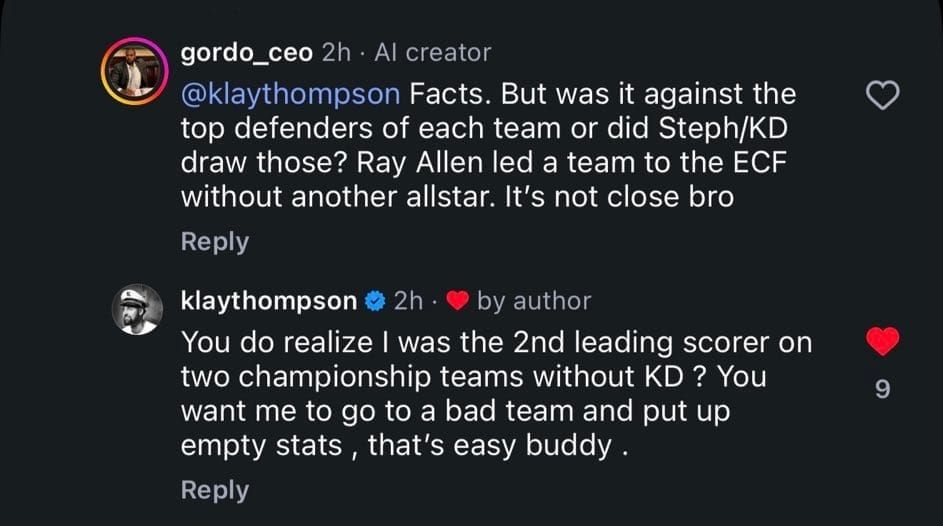
Which is why I found Klay Thompson's recent response to people comparing the two a bit troubling.
During an Instagram argument over whether Allen or Thompson had the better career, Klay defended himself by pointing out that he was the second-leading scorer on two championship teams without Kevin Durant. When a fan brought up Allen carrying a larger offensive burden, Thompson responded that going to a bad team and putting up “empty stats” would have been easy.
He also reminded everyone that he led the 2016 playoffs in total points.
As ClutchPoints reported while documenting the exchange, Klay's response was essentially: stop treating playing beside Stephen Curry like proof that I couldn't have scored more somewhere else.
And you know what?
I wholeheartedly agree with part of that.
One of the laziest ways to talk about Klay Thompson is to call him a glorified role player who got lucky enough to spend his prime beside Steph Curry.
That is ridiculous.
Prime Klay was a five-time All-Star, a two-time All-NBA selection and eventually an All-Defensive Second Team guard. He scored an NBA-record 37 points in a quarter. He scored 60 points in 29 minutes. He made a then-playoff-record 11 threes in an elimination game against Oklahoma City.
In 2016, Klay averaged 24.3 points during Golden State's postseason run and finished with 582 total playoff points, more than anybody else that year. His Game 6 against Oklahoma City remains one of the greatest playoff performances I have ever watched live.
And Klay did all of this while rarely requiring an offence to be designed around him.
That matters.
Every championship team wants scoring.
Very few players can provide superstar-level scoring stretches without demanding superstar-level possession time.
That was Klay's superpower.
But Klay's argument loses me when we get to the “bad team” and “empty stats” part.
Because which Ray Allen are we talking about?
It cannot be the 2001 version.
Milwaukee won 52 games that season.
The Bucks reached Game 7 of the Eastern Conference Finals.
Across 18 playoff games, Allen averaged 25.1 points and six assists while shooting 47.9 per cent from three.
Six assists.
Not two.
Not one-and-a-half.
Six.
In the NBA's deadball era (1997 - 2004).
The NBA's own retrospective on Allen's career specifically highlights that Milwaukee season as one of the defining periods of his prime: a 52-win contender that came within one game of reaching the NBA Finals.
That is not empty production.
That is being one of the principal offensive players on a championship contender.
It is also not some random one-year statistical anomaly.
After Milwaukee traded Allen to Seattle, he eventually led another 52-win team.
The 2004-05 SuperSonics went 52-30, finished first in their division and reached the Western Conference semifinals. Allen averaged 23.9 points during the regular season and then increased that to 26.5 in the playoffs.
He was named All-NBA Second Team.
Not Third Team.
Second.
According to the NBA's official history of All-NBA selections, the guards ahead of Allen on First Team that year were Steve Nash, who won the first of his two MVP's, and Allen Iverson, who averaged more than 30 points.
Ray was not being evaluated like a specialist.
He was being evaluated like one of the best guards in basketball.
That distinction is where I think the entire Klay-Ray debate gets screwed up.
People are comparing roles instead of players.
Ray Allen eventually became something resembling the player people now remember him as.
He did not start there.
Before Boston and Miami, Allen was creating significantly more offence with the ball.
He could run pick-and-roll.
He could attack closeouts.
He could pull up off the dribble.
He could get downhill.
He could create shots late in the clock.
And perhaps most importantly for this comparison, teams actually asked him to create for other people.
His final Seattle season might be the clearest example.
Allen averaged a career-high 26.4 points, 4.5 rebounds and 4.1 assists while playing more than 40 minutes per game.
The NBA's official statistics from the 2006-07 season show Allen finishing sixth in the entire league in scoring.
The five players ahead of him were Kobe Bryant, Carmelo Anthony, Gilbert Arenas, Dwyane Wade and LeBron James.
That is the neighbourhood Ray Allen lived in.
Klay's highest scoring season was 22.3 points per game.
His highest assist average was 2.9.
That does not prove Klay couldn't have averaged 26 points as the first option somewhere.
This is where these debates usually become unfair.
We cannot punish someone for succeeding at the job he was actually given because we wish he had gone to Charlotte for three years so we could run the experiment.
Klay's 37-point quarter alone tells me his scoring ceiling in an individual game was almost nonsensical.
His 60-point performance against Indiana might be an even better example.
According to NBA.com's retrospective on the game, he became the first player in league history to score at least 60 points while playing fewer than 30 minutes.
I have no doubt Klay could have averaged more points somewhere else.
What I do not know is whether he could have carried the same possession-by-possession responsibility Allen did for an entire season while maintaining the efficiency, defence and off-ball movement that made him Klay Thompson.
Nobody knows.
That season never happened.
Ray's did.
And that is the difference between demonstrated ability and a hypothetical.
Klay's low assist numbers also do not prove he could not pass.
They tell us that Golden State did not ask him to organize its offence.
Steph did that.
Draymond did that.
Klay's job was often to bend a defence without touching the ball long enough for the defence to realize it had already made a mistake.
There is tremendous value in that.
Actually, I think basketball discourse routinely underrates it.
We have spent decades teaching ourselves that the guy doing the most with the ball must automatically be the most valuable player.
Klay is one of the best arguments against that idea.
Put another ball-dominant scorer beside Steph and Kevin Durant and somebody eventually has to sacrifice what makes him comfortable.
Put prime Klay beside them and tell him he might get 12 shots tonight instead of 18?
Good luck losing him.
He will run another kilometre around screens until somebody forgets where he went.
Then he will hit four threes in six minutes and make the entire discussion irrelevant.
That portability is part of Klay's greatness.
So was his defence.
Box scores are especially bad at capturing what prime Klay gave Golden State on that end because his job frequently involved absorbing difficult perimeter assignments rather than accumulating huge steal numbers.
His 2019 All-Defensive Second Team selection at least gives us contemporary award evidence that people watching him at his peak understood that value.
This is why I do not think Ray having 10 All-Star appearances to Klay's five ends the argument.
Just like I do not think Klay having four championships to Ray's two ends it.
Those are pieces of evidence.
They are not the verdict.
There is one statistic, however, that I think explains their careers better than almost anything else.
In 2005-06, Ray Allen made 269 three-pointers.
It was an NBA record.
Ten years later, Klay Thompson made 276.
If you divide the totals by games played, both come out to almost exactly 3.45 made threes per game.
The production was basically identical.
The basketball world around them was not.
The NBA's history of the three-point revolution notes that Allen's 269 established the league record and that the mark was eventually surpassed repeatedly as three-point volume exploded.
Klay's 276 came during the 2015-16 season.
Steph Curry made 402.
On the same team.
That is insane.
And it does not mean Ray was automatically a better shooter because his number was more unusual for the era.
Nor does Klay's slightly higher career three-point percentage automatically make him better.
It means they were solving different versions of basketball.
When Allen entered the league, coaches still viewed a lot of threes as settling.
By the middle of Klay's prime, Golden State had helped turn the three from a supplementary weapon into the organizing principle of an offence.
Ray was stretching what teams believed a great shooter should be allowed to do.
Klay and Steph helped blow that boundary apart.
Which brings us to Boston.
This is where I think basketball memory starts playing tricks on people.
Allen averaged 26.4 points during his final season in Seattle.
Then he was traded to Boston.
Kevin Garnett arrived.
Paul Pierce was already there.
Ray's scoring immediately fell to 17.4 points per game.
If somebody only looked at those two numbers without understanding what happened, it might look like Allen suddenly declined by nine points.
He did not.
His job changed.
Allen still started all 73 games he played during Boston's 2007-08 championship season and averaged almost 36 minutes.
During the playoffs, he started all 26 games and averaged 38 minutes.
Boston Ray was more complementary than Seattle Ray.
He was not yet Miami Ray.
That version came later.
By Allen's final year in Boston, ankle problems and Avery Bradley's emergence had started changing the rotation around him. He eventually lost his automatic starting spot.
Then he left.
One of the things that gets lost in the emotion surrounding Allen leaving Boston is that he actually turned down more money to join Miami.
As Jackie MacMullan reported for ESPN at the time, Boston offered Allen two years and $12 million along with a no-trade clause. Miami's offer paid substantially less.
The decision involved more than one thing. Allen had spent years hearing his name in trade rumours, his role had decreased, his relationship with Rajon Rondo had reportedly deteriorated and Boston's guard hierarchy was changing.
Reducing the entire decision to “Ray ring-chased” has always been too simple.
But what happened after the move is even more relevant to Klay.
Allen arrived in Miami and accepted the role.
A real bench role.
Not third star.
Not reduced starter.
Bench player.
During the 2012-13 regular season, Allen played 79 games.
He started zero.
He averaged 10.9 points in 25.8 minutes.
According to ESPN's reporting on Allen embracing Miami's reserve role, Erik Spoelstra made the expectations clear during recruitment and Allen understood what Miami needed from him.
Then, of course, came the corner.
Five-point-two seconds.
Chris Bosh rebound.
Backpedal.
Bang.
And suddenly the defining image of Ray Allen's career was created by the most specialized version of Ray Allen that had ever existed.
That shot helped save Miami's championship.
It also helped erase part of Allen's basketball identity.
A generation of fans saw the corner three.
They saw Boston Ray flying around screens.
They saw Miami Ray coming off the bench.
Then they worked backwards and assumed Ray Allen had basically always been that player.
He had not.
And this is where the current Klay situation becomes almost too perfect.
In February 2024, Steve Kerr finally moved Thompson to the bench.
Klay did not love it.
Why would he?
This was somebody who had spent more than a decade starting for one of the greatest dynasties in professional sports, had torn his ACL, torn his Achilles, missed two complete seasons, fought his way back and then helped Golden State win another championship.
Being told you are no longer a starter probably does not feel like a strategic lineup adjustment.
It probably feels like someone telling you that you are no longer the person you remember being.
But Klay eventually responded exactly how a great player should.
In his first game off the bench, he scored 35.
Afterward, as ESPN reported, Thompson said he had two choices: “pout” or “respond.”
He responded.
That is why I do not think the Ray Allen comments make Klay some giant hypocrite.
I think they make him human.
It is really easy to understand why an older star should accept fewer shots, fewer minutes or a bench role when you are watching somebody else do it.
It becomes much harder when the word “veteran” suddenly means you.
By 2025-26 in Dallas, Klay was averaging 11.7 points and starting only eight games.
That is much closer statistically to Miami Ray Allen than prime Golden State Klay ever was.
And now we have another layer.
On August 21, Dallas agreed to buy out the remainder of Thompson's contract.
According to Associated Press reporting carried by Sportsnet, Thompson intends to sign with Miami once he clears waivers.
Miami.
Of course.
Ray Allen joined Miami at 36, turning 37.
Klay is 36.
Ray arrived after his starting role had disappeared.
Klay has spent the last few seasons confronting the same transition.
Ray arrived as a veteran shooting specialist around established stars.
If the reported move is completed, Miami will be asking Klay to provide something very similar.
Basketball history apparently has a sense of humour.
The comparison becomes even better when you remember that Klay genuinely respects Allen.
Earlier this year, when Thompson moved up the NBA's career three-point leaderboard, he specifically credited Ray and Reggie Miller.
As The Athletic's NBA.com feature on Klay's pursuit of the three-point legends noted, Thompson said he watched Miller and Allen “religiously” as a teenager.
So I do not think this needs to become some manufactured Klay-versus-Ray beef.
The basketball argument is much more interesting than that.
If you ask me who was the better overall player, I am taking Ray Allen.
I think the evidence for that is stronger.
A decade of All-Star appearances compared with five.
A Second Team All-NBA peak compared with Third Team.
A 26.4-point scoring peak in a slower paced era compared with 22.3.
Multiple seasons demonstrating that he could be the primary perimeter scorer.
Playoff runs in which he simultaneously produced high-level scoring and meaningful playmaking.
That is more offensive responsibility than Klay ever demonstrated across a full season.
But if you ask me which player I would rather add to a team that already has a championship-level first option?
That gets much more difficult.
Maybe I take Klay.
Prime Klay could guard the opponent's best perimeter scorer, space the floor 30 feet from the basket and score 25 points without requiring everybody else to change how they played.
Put him beside Steph.
Works.
Add Draymond.
Works.
Add Kevin Durant.
Still works.
Take Durant away.
Still works.
That is not a limitation.
That is a basketball skill.
And if you ask me who the better shooter was?
I am not pretending 2,973 versus 2,899 settles that either.
The environments were too different.
Allen's three-point volume was radical for his time.
Klay helped create the league in which that volume stopped looking radical.
Allen produced more of his offence off the dribble.
Klay is greatest instantaneous catch-fire scorer ever, in my humble opinion.
Pick whichever definition of “shooting” you prefer and you can probably build a respectable argument.
But first you have to remember who the players actually were.
That is the part of Klay's comments I disagree with most.
Ray Allen's pre-Boston production was not empty.
The 2001 Bucks were not bad.
The 2005 Sonics were not bad.
And Ray was not putting up numbers simply because somebody had to shoot.
He was doing it because for a significant portion of his career, Ray Allen was one of the best offensive guards in basketball.
Then he became something else.
That second version extended his career.
It helped him win two championships.
It produced one of the most famous shots in NBA history.
And ironically, it became so successful that people eventually forgot the player who came before it.
Klay may now be entering the same stage.
Through the end of last season, Ray remained at 2,973 career threes.
Klay had 2,899.
Seventy-four behind.
If Klay's expected move to Miami happens and he remains healthy, there is a very real possibility that he passes Ray Allen on the career three-point list while wearing a Heat uniform.
I hope it happens that way.
Because there would be something perfect about Klay Thompson passing Ray Allen in Miami while occupying the type of late-career role that caused so many people to misunderstand Ray Allen in the first place.
Ray had to become a specialist.
Klay became an era defining legend while mastering a more specialized offensive role during his prime.
Those are two very different careers.
Both are incredible.
So if you ask me Ray or Klay?
I still have Ray.
But before we have the argument, make sure we are talking about the right Ray Allen.
Sources
Klay Thompson Claps Back at ‘Casuals’ After Ray Allen Career Comparison — ClutchPoints
Archive 75: Ray Allen — NBA.com
Ray Allen Career Statistics — NBA.com
Year-by-Year All-NBA Teams — NBA.com
NBA's 3-Point Revolution: How One Shot Changed the Game — NBA.com
Legendary Moment: Klay Thompson Scores 60 in 29 Minutes — NBA.com
Klay Thompson Comes Off Bench and Scores 35 — ESPN
Ray Allen Left Boston Despite No-Trade Clause — ESPN
Ray Allen Joining Miami Heat — ESPN
Allen Follows Ginobili's Path Off the Bench — ESPN
Klay Thompson Intends to Sign With Miami After Mavericks Buyout — Sportsnet / Associated Press
2004-05 Seattle SuperSonics Roster and Statistics — Basketball-Reference