The Abbot’s Impossible Machine: How RZA Built Hip-Hop’s Most Ambitious Dynasty
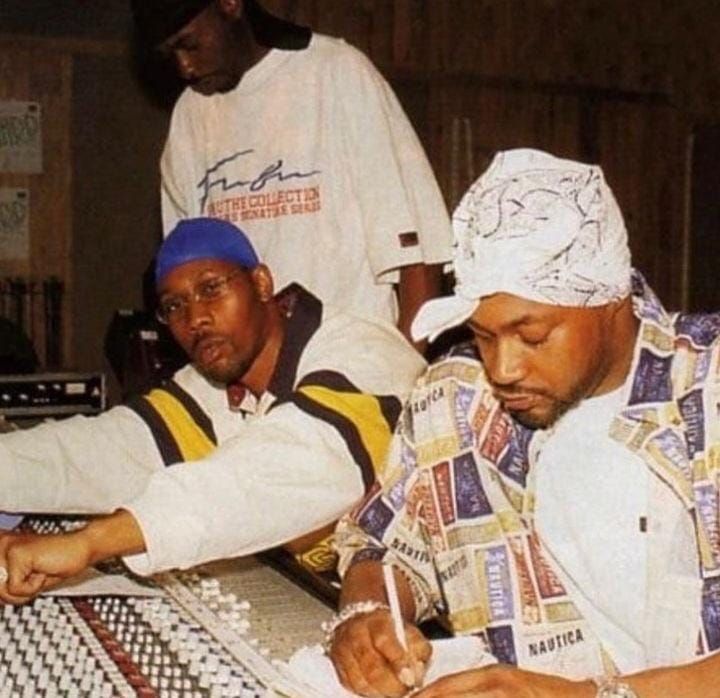
He could convert poverty into texture, competition into sequencing, martial-arts movies into mythology, separate record contracts into collective promotion, individual personalities into album identities and eventually other producers’ beats into records that still sounded unmistakably Wu-Tang.
The argument usually begins the way the best rap arguments begin: with a few people talking too loudly about records they have heard too many times to discuss calmly.
The names change depending on the day. DJ Premier. Dr. Dre. Pete Rock. J Dilla. Kanye West. Marley Marl. Q-Tip. The criteria usually change as soon as one contender starts losing. Singles become albums. Influence becomes consistency. Drums become innovation. Longevity becomes peak. There is no clean way to settle it because producing is not one job and greatness is not one measurement.
Still, the RZA case refuses to go away.
Between the release of Enter the Wu-Tang (36 Chambers) in November 1993 and Ghostface Killah’s Supreme Clientele in February 2000, Robert Diggs did something stranger than accumulate great beats. He helped turn a crowded group of Staten Island rappers into a decentralized recording empire whose albums appeared on competing corporations but shared a language, mythology, cast of characters, sound and visual identity.
Calling it the greatest producer peak in hip-hop history is provocative but incomplete. I think the stronger argument is that no producer has ever constructed a rap dynasty quite like RZA did during that period.
The key to understanding the run is that RZA’s greatest skill was not simply production.
It was conversion.
He could convert poverty into texture, competition into sequencing, martial-arts movies into mythology, separate record contracts into collective promotion, individual personalities into album identities and eventually other producers’ beats into records that still sounded unmistakably Wu-Tang.
That ability appeared almost immediately.
Wu-Tang entered a New York rap scene undergoing a transfer of power. Public Enemy’s imperial period was ending. EPMD had broken apart. Eric B. & Rakim had separated. At the same time, Dr. Dre’s The Chronic and Snoop Doggy Dogg’s Doggystyle had made Los Angeles the centre of rap’s commercial imagination.
New York was not artistically empty, but its next order had not consolidated. Hot 97 did not become a full-fledged hip-hop station until October 1993, according to Complex’s oral history of the station, just as Wu-Tang, Nas, the Notorious B.I.G. and Mobb Deep were preparing to reshape the city’s sound.
RZA did not answer California by trying to imitate it.
He exaggerated everything that sounded unmarketable about his own environment.
The bass was not smooth but bruising. Samples did not glide through the mix; they sounded burned, drowned or cut off halfway through a thought. Voices crowded one another. Edits arrived without warning. Kung-fu dialogue interrupted songs like messages from another dimension.
In a Library of Congress interview, RZA discussed the relationship between the environment artists came from and the music they created, contrasting the physical openness of California with the density and concrete of New York housing projects.
His broader point was that geography eventually becomes sound.
That is why I think the best description of 36 Chambers is that it sounds like public infrastructure failing in real time.
Some of that atmosphere was intentional, and some of it came from deprivation. Pitchfork’s retrospective on 36 Chambers describes the early recording environment as cheap, cramped and technically limited. RZA was working with old records, inexpensive equipment and whatever sonic damage the room itself introduced. On “Bring da Ruckus,” he even used improvised percussion involving a microphone and a paint bucket.
The result is usually described as lo-fi, but that term almost makes the album sound passive, as though fidelity simply failed.
36 Chambers is better understood as an aggressive use of limitation.
Sounds become larger because information has been removed from them. A piano fragment becomes more threatening because the surrounding harmony is gone. A vocal sample becomes supernatural because its original context has disappeared. Drums hit harder because they do not sit politely inside a balanced mix.
RZA has argued that the pressure improved the record. In his Library of Congress interview, he described how limited money and studio time created urgency and forced decisions. He also discussed the competitive process by which Wu-Tang members fought for space on songs and how he sometimes shortened verses to make the records work.
Nine rappers should have created a logistical disaster.
RZA turned the overcrowding into competition.
Method Man could bend around a beat with casual elasticity. GZA wrote in carefully joined propositions. Raekwon compressed street information into hard, efficient lines. Ghostface Killah sounded as if the emotional climax had already happened before he entered the song. Inspectah Deck attacked structure. U-God provided baritone weight. Masta Killa waited and landed precisely. Ol’ Dirty Bastard treated meter as a suggestion.
RZA’s accomplishment was not making those voices resemble one another.
It was making their differences sound like parts of the same argument.
The martial-arts samples gave those collisions a larger narrative purpose. RZA and ODB had spent years watching kung-fu films, and the group eventually borrowed imagery from movies such as The 36th Chamber of Shaolin, Shaolin and Wu Tang and Five Deadly Venoms. As discussed in Pitchfork’s history of the debut, the films shaped more than the group’s name. Their language, rivalries, techniques and philosophies became part of how Wu-Tang imagined itself.
The dialogue was not merely decoration. A sample could establish a rivalry, introduce a technique, announce a trial or turn the next rap verse into combat.
The movies also offered an organizational language. Masters trained pupils. Schools developed styles. Warriors possessed individual techniques while fighting under a common banner.
Staten Island became Shaolin.
Microphone skill became swordsmanship.
A group from New York’s forgotten borough acquired the scale of legend.
Five Percent teachings supplied another layer. An analysis from Washington University in St. Louis traces the debut’s use of Five Percent concepts, numerical symbolism, knowledge of self and ideas surrounding the “Original Man.” Not every member related to the Nation of Gods and Earths in exactly the same way, but those ideas helped make Wu language feel like a system rather than simply a collection of slang terms.
That was RZA’s first great conversion.
Kung-fu cinema supplied movement and hierarchy. Five Percent language supplied cosmology. Staten Island supplied geography.
RZA’s production supplied weather.
The mythology, however, would not have survived without an equally unusual business decision.
After the independently released “Protect Ya Neck” created local demand, Wu-Tang attracted major-label interest. RZA and the people around him did not simply seek the largest advance. They wanted the group contract to leave individual members free to negotiate solo deals with other record companies.
The strategy allowed Wu-Tang to spread across the industry. Method Man went to Def Jam. Ol’ Dirty Bastard signed with Elektra. GZA released through Geffen. Ghostface aligned with Epic and Razor Sharp. Raekwon remained within the Loud/RCA system.
Method Man later explained the importance of that arrangement when discussing Wu-Tang’s business structure, as reported by Complex. Members could appear on competing labels while every company still had an incentive to participate in the growth of the larger Wu brand.
What could have fragmented the group instead became another form of distribution.
Every successful solo record advertised the others.
A Ghostface appearance on Raekwon’s album created demand for Ghostface. Method Man appearing on another member’s project reminded Def Jam listeners that his career belonged to a universe larger than Def Jam. The yellow Wu-Tang “W” could sit above competing corporate logos because, from the listener’s perspective, the labels were distributing different sections of RZA’s world.
That may be the most important business achievement of the entire run.
RZA converted decentralization into cohesion.
Then he had to make the music justify the idea.
Tical arrived first in November 1994. Method Man was the obvious opening move. His voice was instantly recognizable, his flow was fluid and “Method Man” had already functioned as a solo showcase on 36 Chambers.
The easy decision would have been to treat him like a ready-made crossover star.
RZA gave him a fog instead.
Tical sounds enclosed. Bass collects in corners. Piano notes feel corroded. Vocal fragments hover without identifiable bodies. Method Man moves through the production as if he is trying to maintain balance in a room whose floor keeps shifting.
That is why I think RZA’s smartest decision was not simply complementing Meth’s charisma.
He complicated it.
Tical makes Method Man’s ease sound like a defence against anxiety.
The album also demonstrates how much of RZA’s genius came from responding to disasters he did not plan. Flooding in his basement studio destroyed equipment and music connected to early Wu solo sessions, forcing some material to be rebuilt. Pitchfork’s retrospective on Tical discusses how the finished record was shaped by those circumstances.
That distinction matters.
The Wu albums were not perfectly planned concepts descending from RZA’s imagination. Sometimes the concept emerged because something had gone wrong and he figured out how to make the damage useful.
Ol’ Dirty Bastard made that job even harder.
Return to the 36 Chambers: The Dirty Version arrived in March 1995 and sounds like a record constantly threatening to reject the idea of being a record.
ODB repeats himself, abandons normal song logic, sings beyond conventional pitch and jumps between comic precision and apparent disarray.
RZA’s job was not to discipline him into normality.
It was to put enough structure around ODB that the instability became understandable.
“Shimmy Shimmy Ya” barely needs anything beyond its piano figure, drums and vocal command. “Brooklyn Zoo” uses emptiness as threat. The album often sounds unfinished because ODB’s entire performance style treats finish as a form of containment.
Pitchfork’s retrospective on Return to the 36 Chambers describes how ODB’s unpredictability and rejection of conventional respectability became essential to the record rather than problems it needed to solve.
Then came the two records that make the RZA argument almost unfair.
Raekwon’s Only Built 4 Cuban Linx... is regularly called cinematic, but that word has been applied to so many rap albums that it barely means anything anymore.
Its achievement is not that it sounds like an expensive movie.
It has point of view.
Characters return. Alliances matter. Betrayals have consequences. Voices reappear across scenes. Criminal aliases create another layer of identity. Dialogue from movies such as John Woo’s The Killer makes the record feel as though the listener has entered a continuing world rather than a collection of unrelated songs.
The most important instrument on the album may be the relationship between Raekwon and Ghostface.
Raekwon gives information shape. Ghostface makes the same environment feel feverish and emotionally unstable. Their styles are different enough to create tension but close enough to suggest shared experience. The result is a partnership so strong that Ghostface feels less like a guest than a second lead.
Pitchfork’s retrospective on Only Built 4 Cuban Linx... emphasizes the importance of the relationship between Raekwon and Ghostface to the album’s lasting power.
That is exactly why RZA’s production works.
His beats are not simply dark scenery. They create the emotional conditions under which that relationship can exist.
Some tracks operate through a few threatening notes and drums. Others become soul melodramas. The important part is that RZA never mistakes “cinematic” for “busy.”
He knows when a scene needs grandeur and when it needs an empty room.
Three months later, Liquid Swords showed that he could take almost the opposite approach.
Where Raekwon and Ghostface fill the frame with movement, GZA reduces it.
His writing proceeds through carefully arranged images, analogies and conclusions. RZA responds with space. Bass, drums and restrained melodic fragments produce a feeling of low temperature. Dialogue from Shogun Assassin turns the album into an education in discipline, violence and consequence.
Pitchfork’s retrospective on Liquid Swords treats the album as one of the purest distillations of the Wu-Tang aesthetic.
I would go slightly further.
It may be the cleanest example of RZA designing an environment around the psychology of one rapper.
By the end of 1995, that became the real promise of a Wu-Tang solo album.
You were not just getting one member rapping over leftover Clan beats.
You were entering another custom chamber inside the same fortress.
Ghostface’s Ironman completed the first great cycle in October 1996.
It is warmer than Liquid Swords, but the warmth is rarely comforting. RZA uses soul and jazz textures that normally suggest intimacy and puts them under pressure. The record can sound romantic, bruised, paranoid and nostalgic within a few minutes.
“All That I Got Is You” is the most obvious break in the armour, turning childhood poverty and maternal devotion into the emotional centre of the album. But the whole record is less tidily organized around a single persona than Tical or Liquid Swords. Raekwon and Cappadonna occupy major space, and Ghostface sometimes seems to emerge from a larger neighbourhood rather than stand cleanly in front of it.
Pitchfork’s retrospective on Ironman describes the record as Ghostface reconstructing the world of his youth through RZA’s soul-heavy production.
Again, RZA is converting circumstance into form.
That is what makes his run more impressive to me than the idea of a flawless mastermind executing a five-year blueprint exactly as planned.
He was not merely an auteur.
He was an emergency coordinator.
The murk of Tical, the instability surrounding ODB and the fragmented intimacy of Ironman emerged from personalities, accidents, health problems, money problems, legal problems and limited time. RZA kept turning those disruptions into records that felt intentional enough to become part of Wu mythology.
By June 1997, he was trying to do that at a much larger scale.
Wu-Tang Forever arrived as a double album and debuted at No. 1 in the United States, knocking the Spice Girls from the top position. Its lead single, “Triumph,” ran almost six minutes and had no conventional chorus. As Crack Magazine noted in its retrospective, the group had reached the top of the charts with a sprawling double album that made few concessions to conventional pop structure.
Wu-Tang had become commercially enormous without suddenly becoming simple.
The production also expanded. Strings and synthesizers became more prominent. RZA delegated more work to 4th Disciple, True Master and Inspectah Deck. The sound was larger and cleaner without completely abandoning the darkness of the first cycle.
“Triumph” justified the title by itself. Inspectah Deck opens with one of the defining verses of the entire Wu catalogue, and the procession that follows demonstrates how much the members had developed since 1993.
They sounded victorious because they were.
But Wu-Tang Forever is also where the contradictions of the system became difficult to hide.
Some members had successful solo careers. Others were still waiting for equivalent opportunities. Individual contracts meant individual schedules, managers, advances and priorities. The same structure that allowed Wu-Tang to infiltrate the record industry also created competing centres of power inside the group.
Pitchfork’s retrospective on Wu-Tang Forever describes a collective beginning to experience the effects of solo success, changing priorities and growing internal tension.
That is the central paradox of RZA’s plan.
It worked so well that it weakened the conditions that had allowed it to work.
The members no longer needed the centre in the same way.
Method Man had become a crossover star. Raekwon and Ghostface had developed their own partnership. ODB was becoming increasingly difficult to contain personally and professionally. Other members had understandable reasons to question when their opportunities would arrive and how resources were being distributed.
The business structure could multiply opportunity.
It could not make opportunity equal.
Those disagreements eventually became public. In his memoir Raw: My Journey Into the Wu-Tang Clan, U-God accused RZA of exercising too much control over aspects of the group’s business and music. RZA rejected that characterization. As Pitchfork reported, RZA argued that a true dictator would not have allowed members to establish the independent contracts and careers that eventually gave them significant control over their own futures.
I do not think the RZA argument requires choosing one side and pretending the other never happened.
Both positions reveal something about the structure.
RZA’s concentration of authority helped create Wu-Tang.
The success created by that authority eventually gave everyone else enough leverage to challenge it.
The music changed alongside the institution.
On Bobby Digital in Stereo, RZA moved toward keyboards, synthetic textures and a more electronic approach. The Bobby Digital persona gave him space to explore another version of himself, but the album also announced that the producer who had built the early Wu sound was no longer interested in endlessly recreating it.
His obsession with cinema became literal.
In 1999, Jim Jarmusch’s Ghost Dog: The Way of the Samurai gave RZA a film to score. Pitchfork’s retrospective on the soundtrack treats the project as a natural extension of the cinematic language that had already defined his work with Wu-Tang.
I think that distinction is important.
RZA did not suddenly leave Wu-Tang behind to become interested in film.
He had been scoring imaginary films for years.
The problem was that the second cycle of Wu solo albums could no longer recreate the near-perfect sequence of the first. Follow-ups from several members did not receive the same critical response as their debuts. Inspectah Deck’s solo arrival was delayed. The Wu brand was still enormous, but the assumption that every new chamber would contain another classic was gone.
Then Ghostface returned.
Supreme Clientele did not restore the original Wu-Tang production model.
It proved that RZA no longer needed that model.
Ghostface’s writing had become even more associative. Clothing, food, celebrities, childhood memories, street violence, jokes, religion and television could collide inside the same verse without being neatly translated for the listener.
Meaning accumulated faster than explanation.
The production came from everywhere.
Mathematics made “Mighty Healthy.” Hassan produced “Apollo Kids.” Carlos Bess handled “Cherchez La Ghost.” JuJu, Inspectah Deck, Black Moes-Art, Carlos Broady and others contributed to the record.
RZA was no longer the exclusive beatmaker behind a chamber designed from scratch.
That is what makes the album so important to my argument.
He did not need to be.
As Pitchfork’s retrospective on Supreme Clientele explains, RZA played a major role in assembling and shaping productions from multiple sources. Different producers contributed individual pieces, but the finished album still sounded unified.
RZA had become less like a cinematographer shooting every frame himself and more like an editor taking footage from several cinematographers and cutting it into one movie.
That is where the conversion thesis becomes clearest.
His deepest gift was never exclusivity.
He could convert a pile of unrelated beats into a Ghostface record that sounded unmistakably like part of the universe he had started building seven years earlier.
Supreme Clientele also points toward what came next in hip-hop. Kanye West later credited Ghostface with influencing his approach, while RZA’s manipulation of soul samples became an important precedent for the sped-up soul production that would become central to early-2000s rap. Pitchfork’s history of Supreme Clientele also connects the album’s production process to methods that would become increasingly common in the following decade.
I would still be careful about turning influence into a straight family tree.
Kanye was not simply RZA 2.0. Neither were Just Blaze or the generations of producers and collectives that followed. Artists borrow from multiple places at once.
But the larger Wu-Tang proposition is difficult to ignore.
A rap group could become more than a rap group.
It could become a mythology, logo, clothing brand, production circle, talent incubator and federation of solo careers. Its members could compete against one another without automatically destroying the value of the whole. Different record companies could distribute different parts of the same universe.
RZA proved that at a scale hip-hop had not seen before.
The accomplishment cannot be separated from its costs.
The system worked partly because one person possessed enormous creative authority over a group of young artists who trusted him, depended on him, competed for his attention and eventually developed enough individual power to stop accepting his decisions automatically.
The solo deals liberated Wu-Tang from one corporation.
Over time, they also liberated individual members from one producer.
The mechanism that allowed RZA to build the empire contained part of the mechanism that eventually weakened his ability to control it.
That is why the run still feels almost impossible.
It required young artists hungry enough to accept a central creative authority, nine personalities talented enough to justify decentralization, record companies willing to compete for separate pieces of the same group and a producer capable of making each piece advertise the whole.
For several years, RZA turned every contradiction into momentum.
So, did RZA have the greatest producer peak in hip-hop history?
Maybe.
I still do not think there is a useful instrument that can measure something like that. Dr. Dre, DJ Premier, Pete Rock, J Dilla, Kanye West, Marley Marl and Q-Tip can all make arguments based on criteria that favour what they did best.
The stronger RZA argument does not require beating every one of them in an imaginary tournament.
From 36 Chambers to Supreme Clientele, he demonstrated that producing a movement can mean something larger than producing its beats.
It means deciding how the characters enter.
How their world sounds.
How separate personalities fit together.
How mythology turns into branding.
How competition becomes business.
How disaster becomes aesthetic.
How authority expands.
And, eventually, what survives when the centre can no longer hold.
RZA’s greatest instrument was not the sampler.
It was conversion.
Sources
Library of Congress. “Interview with RZA.” May 4, 2022.
Pitchfork. “Wu-Tang Clan: Enter the Wu-Tang (36 Chambers).” October 9, 2022.
Complex. “The Oral History of Hot 97’s Summer Jam.”
Washington University in St. Louis. “Enter the Five Percent: How Wu-Tang Clan’s Debut Album Maps the Complex Doctrine of the Five Percent Nation.”
Complex. “Method Man Says He Hasn’t Watched Any Episodes of ‘Wu-Tang: An American Saga.’” May 10, 2023.
Pitchfork. “Method Man: Tical.” October 9, 2022.
Pitchfork. “Ol’ Dirty Bastard: Return to the 36 Chambers: The Dirty Version.” March 28, 2020.
Pitchfork. “Raekwon: Only Built 4 Cuban Linx...”
Pitchfork. “GZA: Liquid Swords: Chess Box Deluxe Edition.” July 27, 2012.
Pitchfork. “Ghostface Killah: Ironman.” October 9, 2022.
Crack Magazine. “20 Years of Wu-Tang Forever.” June 2, 2017.
Pitchfork. “Wu-Tang Clan: Wu-Tang Forever.” October 9, 2022.
Pitchfork. “RZA Responds to U-God Calling Him a ‘Control Freak’ in Memoir.” April 4, 2018.
Pitchfork. “RZA: Ghost Dog: The Way of the Samurai.” October 9, 2022.
Pitchfork. “Ghostface Killah: Supreme Clientele.” June 4, 2017.
The New Yorker. “The Way of the Wu.” December 2014.