Why the CEBL Matters
The Raptors helped make basketball national in Canada. The CEBL matters because it makes professional basketball local.
I think one of the easiest ways to misunderstand the Canadian Elite Basketball League is to judge it by what it is not.
It is not the NBA.
The arenas are smaller. The salaries are smaller. The television audiences are smaller. Nobody walking into a CEBL game is going to mistake it for Game 7 of the NBA Finals at Madison Square Garden.
But I also do not think that is the correct way to measure why the league matters.
In fact, I think its smaller scale is part of the reason it does.
I should mention my bias early because, unlike most of the topics I write about, my opinion of the CEBL does not come entirely from watching games, reading articles or researching numbers.
I serve as an assistant team manager for the Scarborough Shooting Stars.
So when I talk about what professional basketball can mean to a community, much of my argument comes from what I have been able to see while working around the team.
It comes from seeing a the Pan-Am Centre filled with schoolchildren during a weekday game. It comes from watching players interact with kids who were sitting in class a few hours earlier. It comes from watching local businesses come into the arena, community groups become part of game night and cultures that actually make up Scarborough become part of the presentation.
It even comes from things most fans would probably never think about, like seeing food for the players after games come from businesses in the area.
None of those things are going to headline SportsCentre or get a dedicated post on The Score.
That might be exactly why they matter.
Before getting there, though, it is important to establish what the CEBL actually is.
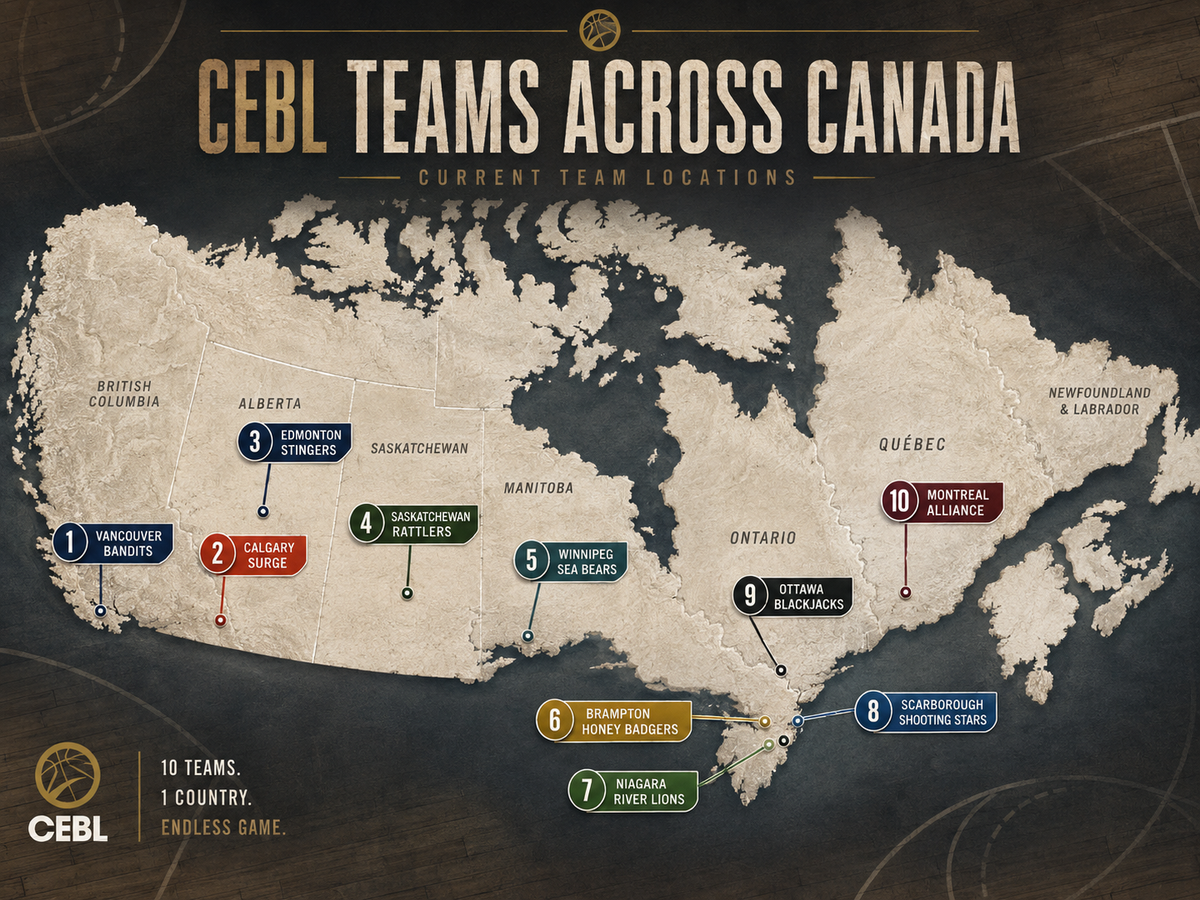
The league is not an unaffiliated summer tournament or semi-professional experiment. Canada Basketball recognizes the CEBL as its official First Division Professional League partner, with games played under FIBA rules. In 2026, the league consists of 10 clubs across six provinces. The CEBL says its audience now reaches roughly 4.1 million Canadians, with half of that audience under 34. In 2025, 17 players with NBA experience appeared in the league, nearly 70 per cent of its players were Canadian and, by 2026, nearly 40 players had signed NBA contracts following CEBL seasons.
Those numbers matter because the basketball has to be legitimate before anything else around it can matter.
Community programming does not mean very much if the product everyone is gathering around is not worth watching.
The CEBL has increasingly proven that it is.
Its five-year relationship with CBC now puts every regular-season and playoff game on national streaming platforms, while select games receive traditional television exposure. More importantly, the league has built a basketball ecosystem that gives Canadian players, coaches, referees, executives and support staff somewhere to work professionally at home instead of requiring almost every meaningful opportunity to exist in the United States or overseas.
That last part means more to me now than it probably would have before I worked in the league.
Professional basketball does not employ only basketball players.
I am an assistant team manager.
Nobody buys a ticket to watch me work.
But my position exists because the Scarborough Shooting Stars exist.
The same applies to coaches, athletic therapists, equipment staff, statisticians, broadcasters, photographers, social-media staff, ticketing staff, sponsorship departments, game-operations crews, marketing teams and executives.
When Canada Basketball's original partnership with the CEBL specifically mentioned developing players, coaches and game officials alongside community and marketing opportunities, that was an important part of the league's potential that can get lost when people reduce development to one question: How many of these players will eventually make the NBA?
The NBA pathway matters.
It just is not the entire ecosystem.
And Scarborough is probably the easiest place for me to explain why.
The Shooting Stars are not simply a Toronto basketball team that happens to play east of Victoria Park.
They are supposed to feel like a Scarborough team.
That begins with ownership. Niko Carino grew up around Sheppard and McCowan and Sam Ibrahim is also a Scarborough native. When the franchise was announced in 2021, Carino told Sportsnet that having the opportunity to help build a professional team carrying the Scarborough name was something he could have dreamed about as a kid growing up there. The organization's original stated goal was not simply to win games. It was to inspire the next generation of players from one of Toronto's most iconic boroughs. Sportsnet's original story on the franchise's Scarborough roots
Jamaal Magloire, the team's vice-president, senior advisor and recent inductee to the Canadian Basketball Hall of Fame, is another Scarborough native and one of the area's most accomplished basketball players, having gone from Eastern Commerce to Kentucky to becoming an NBA All-Star. The team's announcement of Magloire's role
The same connection appears deeper in the organization.
The 2026 roster included Scarborough natives Amari N'Daw and Khalil Miller, alongside a larger collection of players from Toronto, Brampton, Whitby and elsewhere in the GTA. Daniel Mullings and Kyle Johnson, two members of the Shooting Stars coaching staff who have helped lead our community camps, are both from Scarborough.
I want to be precise here because saying “the team is Scarborough” does not mean literally every player, coach, employee and owner was born within Scarborough's borders.
That is not true.
What I mean is that Scarborough runs through the organization in a way that feels difficult to manufacture: founding ownership, senior basketball leadership, parts of the roster and coaching staff, where the team plays, who it partners with and how it presents itself.
Mullings probably summarized it better than I can while helping run one of our camps this year.
“We care about Scarborough,” he said.
Johnson described being able to work with children there as an opportunity to “pay the game forward.”
That is the part of the Shooting Stars story that interests me most.
Obviously, it is not the part that attracts the most attention.
The glitzier version is easy to understand.
Niko Carino is an OVO Sound co-founder. Drake has been around the team. J. Cole actually suited up for Scarborough during the franchise's first season.
The fashion side has been unusually strong for a young Canadian sports franchise too. OVO released an official Scarborough Shooting Stars capsule collection, and Stone Island made Scarborough the subject of its first official collaboration in basketball, creating custom Nylon Metal warm-ups for the team. The broader Drake and OVO world obviously brings associations with brands such as Drake's Nike line NOCTA as well.
That stuff matters.
Professional sports are entertainment.
Cool matters.
Fashion matters.
Celebrity matters.
If a teenager notices the Shooting Stars because he likes the jacket before he cares about the box score, that is still a new basketball fan entering the building.
The OVO leverage gives Scarborough a level of cultural credibility most young basketball teams would have to spend decades trying to develop.
But it is also the easiest part of this story to write about.
Drake sitting in the owners box will get the photograph and it will perform well in the algorithms.
The more meaningful story, to me, is what happens when nobody famous is sitting there.
From working with the Shooting Stars, one of the things I have noticed is that we try to give as many home dates as possible some connection to the community around us.
Sometimes that connection is cultural.
This year there was a Tamil Night against Ottawa. The Canadian Tamils' Chamber of Commerce even tied the game to the Scarborough Health Network Foundation's Tamil Radiothon, with qualifying donors able to receive free tickets. The team also sells its “Vanakkam” Tamil merchandise, giving that relationship an identity beyond a single night. The Tamil Night community ticket initiative
There was Filipino Heritage Night in June, presented with the Philippine Consulate General in Toronto and Scarborough restaurant and lifestyle brand Makilala. The game featured Filipino entertainment and community programming, while Makilala created a limited SSS collaboration and hosted players and staff for a Filipino meal before the game. Coverage of Scarborough's Filipino Heritage Night
There have also been Caribbean Carnival-themed activations that I have experienced through working with the organization.
That distinction matters to me.
If I am going to argue that these things are real, I should also be honest about what I can document publicly and what I know because I was there.
The same applies to food.
One of the small things I have noticed working around the team is how often local vendors enter the basketball operation itself, including post-game meals for players. I cannot point to a public policy stating that a certain percentage of every post-game meal must come from Scarborough businesses, because no such public policy appears to exist.
What I can say is that I have watched it happen.
And there are public examples of the same philosophy, like Makilala feeding the team around Filipino Heritage Night.
To me, that is what “local” should eventually mean.
Not simply putting SCARBOROUGH across a jersey and selling it back to Scarborough.
It means allowing some of the money, attention and opportunities created by the team to circulate through the place whose name is on that jersey.
Other home dates approach community differently.
The Shooting Stars have made School Day games a regular part of the calendar. At one 2025 game, 1,205 fans from 19 schools watched Scarborough beat Ottawa. A year earlier, more than 500 local schoolchildren attended a community school day at Toronto Pan Am Sports Centre where they watched practice and participated in skill-development drills with Shooting Stars players and coaches. Scarborough's 2025 School Day game recap
I think about those games differently now that I work them.
For an adult, an 11 a.m. basketball game can be an unusual scheduling choice.
For a child, it can be the day professional basketball suddenly becomes real.
You leave school.
You walk into an arena.
There are introductions, music, uniforms and referees.
The players are not on a television screen. They are right there.
And afterward, the distance between the kid and the professional athlete can be measured in feet rather than kilometres.
That proximity is difficult to put into a spreadsheet.
I think it is one of the most valuable things the CEBL sells.
Scarborough has also used games to connect to institutions that have nothing to do with basketball.
The franchise's Love, Scarborough partnership with Scarborough Health Network Foundation has turned home dates into fundraisers for local hospitals. The 2025 Love, Scarborough Night raised $10,000 for SHN while honouring healthcare workers, and in 2026 the partnership expanded so that $1 from every online home-game ticket purchased would go toward Scarborough hospitals. Scarborough Health Network Foundation's Shooting Stars partnership
That is the publicly documented event I would use rather than loosely referring to a “Scarborough Appreciation Night.”
The meaning is basically what I was trying to describe anyway: the basketball team serving as a platform for Scarborough itself.
Business owners have been included too.
The CEO Huddle — Business & Basketball brought entrepreneurs and executives together before a home game in partnership with the Scarborough Business Association and Ajax-Pickering Board of Trade. For $30, attendees could participate in networking sessions with business leaders before watching the Shooting Stars play later that evening. The CEO Huddle event page
That might not sound like a basketball initiative.
I think that is the point.
A local professional team can become a meeting place for much more than basketball.
The partnership with Toronto HoopQueens gave me another example I really liked.
In July, Scarborough and HoopQueens turned Toronto Pan Am Sports Centre into a basketball doubleheader. The Shooting Stars played Montréal first, and the HoopQueens Season 5 championship followed on the same court. Both the HoopQueens event listing and Ticketmaster marketed it as one doubleheader experience. The HoopQueens and Shooting Stars doubleheader
That distinction is worth making because I originally remembered it as essentially a two-for-one offer. I could verify the shared doubleheader ticket and event, but not a public promotion using the exact phrase “two for one.”
The larger point survives either way.
A professional men's team used its home date, venue and audience to put another part of Toronto's basketball community directly beside its own product.
That is more meaningful than displaying somebody's logo during a timeout and calling it community engagement.
There are lighter events too.
Scarborough played at home on Canada Day this season, beating Montréal 80-78 after entering the fourth quarter down 13. The organization also operates in-venue 50/50 raffles during home games to support the Shooting Stars Foundation.
And yes, there is OVO Night.
The 2026 version included OVO exclusives and giveaways, access to the SSS x OVO collection and a raffle for a limited OVO Bearbrick. The 2026 SSS x OVO Night listing
Again, I am not against any of that.
A basketball team is allowed to be fun.
I just do not think OVO Night explains why the team matters as well as a School Day game does.
The camps may explain it even better.
The Shooting Stars have expanded SkillSSS programming through PA Day, March Break and summer camps. At one February camp, Mullings and Johnson worked with Scarborough kids between seven and 14 on everything from basic passing and shooting to defensive communication and basketball IQ. The team later added summer sessions in Scarborough as well. The story behind the 2026 SkillSSS camps
Johnson said something after that camp that gets very close to the larger point of this article.
For those kids, seeing a professional team in Scarborough can provide “motivation for them to achieve their highest basketball dreams.”
I do not interpret that to mean every kid will become a professional player.
Most will not.
What matters is that the professional version of the sport is close enough to touch.
That brings me to what may be the biggest reason the CEBL matters to families.
I have a family of five.
If the five of us wanted to go to an average Raptors game today, Ticketmaster says the average ticket can cost somewhere between $100 and $200, depending on the opponent, date, seat and when the ticket is purchased.
For five people, that is approximately $500 to $1,000 in tickets alone.
That is before getting downtown.
Before parking or transit.
Before food.
Before drinks.
Before merchandise.
Before the night out becomes considerably more expensive than the number shown when you first decided to go. Ticketmaster's current Raptors ticket-price guide
I am not criticizing the Raptors for being popular.
There is one NBA team in an entire country.
Scotiabank Arena has a finite number of seats.
Demand changes prices.
The Raptors became a championship organization and one of the NBA's most recognizable international brands. That is what Canadian basketball fans wanted for decades.
But it has produced a completely different live-sports economy from the one many older Raptors fans remember.
During the SkyDome years, former Raptors owner John Bitove recalled being able to sell $5 seats in the 500 level specifically so people who could not otherwise afford NBA basketball could still get into the building. The story of the Raptors' old $5 SkyDome seats
The view apparently required an extremely optimistic definition of the word “view.”
But the kid was inside.
That matters.
There were ticket-access programs around the Raptors ecosystem too. Kids Up Front's 2012 annual report says MLSE Foundation donated 10,000 tickets through its partnership with the organization, and the report includes a parent describing the experience of taking a four-year-old child to a Raptors game through donated tickets.
I am not arguing that the Raptors stopped caring about community access.
That would be unfair.
I am talking about what the ordinary market price of attendance has become.
That is where the CEBL operates in a completely different financial world.
Scarborough has marketed a $180 family package for four that includes four side-bowl tickets, snacks, drinks, popcorn and candy. It is not a perfect apples-to-apples comparison with a five-person Raptors trip, and I do not want to pretend that it is. But the difference in scale is difficult to ignore. Scarborough's 2026 family ticket package
The organization also operates a Community Shooting Star program that allows businesses or individuals to purchase blocks of tickets specifically for schools, youth teams, charities, not-for-profits and other groups that may otherwise face barriers to attending a game. The Community Shooting Star ticket program
That is why I do not see the CEBL as a cheap substitute for an NBA game.
It is doing something the economics of the NBA increasingly make difficult.
It is preserving a version of professional basketball that families can still get close to.
And the argument becomes much stronger once you leave Ontario.
Toronto is home to Canada's only NBA franchise.
A child growing up in Winnipeg does not have the option of asking his parents to drive across town to watch an NBA game.
Neither does a child in Saskatoon, Calgary, Edmonton, Vancouver or most of the rest of the country.
That means professional basketball has historically arrived through a television screen for huge parts of Canada.
The CEBL changes that.
And when I started looking at what teams outside Scarborough actually do in their communities, I realized that the things I have seen with SSS are not isolated.
They take different forms because the communities are different.
That is how it should work.
The Vancouver Bandits were named the CEBL's Community Champion in both 2024 and 2025. Their 2025 programming included 77 on-court sessions, 12 free coaching clinics, six scholarships, seven Indigenous coaching, youth and officiating clinics, a refurbished public court and Filipino, South Asian and Indigenous heritage games. Their Filipino Heritage jersey also raised money for organizations supporting those affected by the tragedy surrounding Vancouver's Lapu-Lapu Day Festival. The Bandits' 2025 community report
Winnipeg has taken another approach.
The Sea Bears run low-cost youth camps taught by their coaches and players. Some 2026 sessions cost only $5.25, included a ticket voucher for a home game and directed registration proceeds to charity. The organization also runs a Youth in Sport Job Shadow Program that puts students alongside staff in marketing, sponsorship, ticketing and game operations. It has worked on public court refurbishments, Indigenous youth camps and free drop-in programming at The Forks. Winnipeg's community initiatives
That job-shadow program particularly stands out to me because it recognizes something Canadian sports development sometimes forgets.
A kid can dream about working in basketball without dreaming about averaging 25 points per game.
Calgary has used access as one of its major community initiatives too. The Surge say they have sent more than 6,500 children and families to games for free over their first three seasons while participating in hundreds of community events around the city.
Saskatoon turned its 2026 season opener into the first “Be Well” School Day Game with Saskatoon Public Schools. More than 1,500 students were expected to attend, with programming focused on belonging, resilience and mental health. The $21 student package included transportation and a ticket to a future Mamba game. Saskatoon's Be Well School Day program
Ottawa built its own School Day Game with Bell Let's Talk around student mental health after the previous year's version drew more than 6,000 people.
Niagara went in another direction entirely.
The River Lions hired captain Kimbal Mackenzie as the CEBL's first full-time Brand & Community Ambassador, keeping a professional player in the region through the offseason to make school visits, coach, mentor young athletes and speak to community groups. By 2026, Mackenzie had become the team's head coach and general manager while retaining that community connection. Niagara's creation of the Brand & Community Ambassador role
And then there is Whitehorse.
In July, Calgary and Saskatoon played the first regular-season professional basketball game ever held in Canada's territories.
But again, the game itself was only part of the idea.
The four-day event also included a local 3-on-3 tournament, a coaches clinic, player appearances throughout the community, Indigenous storytelling, local artists and a youth basketball skills camp. The CEBL's Whitehorse community weekend
That might be the cleanest example of why I think the CEBL matters nationally.
Imagine being a young basketball player in Whitehorse.
The NBA is not coming.
Even most major Canadian professional sports leagues are not regularly coming.
Then professional basketball players arrive in your community, play an actual league game, meet people around town and run a youth camp before leaving.
You cannot replicate that experience by putting League Pass on a television.
This is where I think we sometimes misunderstand what “growing the game” actually means.
We tend to measure it at the top.
How many Canadians are in the NBA?
How many lottery picks did Canada produce?
How good is the national team?
Can Canada beat the United States?
Those are important questions.
But a healthy basketball country also needs a bottom and a middle.
It needs places to play.
It needs affordable games.
It needs coaching.
It needs officials.
It needs jobs.
It needs professional organizations that children can physically enter.
It needs players who go overseas for the winter and can come home during the summer.
It needs U SPORTS athletes who can test themselves against professionals.
It needs somebody who loves basketball but will never play professionally to realize there are still careers in basketball operations, broadcasting, marketing, partnerships, coaching or athletic therapy.
The CEBL can be part of that infrastructure.
That does not mean everything the league does should be accepted as proof of community impact simply because the word “community” appears in a press release.
This is where I think the league still deserves scrutiny.
Most teams are much better at publicly documenting activity than documenting long-term outcomes.
We know how many camps occurred.
We know how many children entered the building.
We know how many school visits happened.
Those are useful numbers.
It is much harder to prove that a child attended one game and became healthier, stayed in basketball longer, developed greater confidence or eventually found a career in sports because of it.
I can tell you what I have seen working in Scarborough.
I cannot responsibly claim to know what happens in every child's life after he or she leaves the arena.
That is an area where I think the CEBL can eventually become better: not only telling us what teams did, but finding ways to measure what those programs produced over several years.
There is another contradiction the league has to live with.
If teams sell themselves as local civic institutions, then relocation matters.
Guelph was one of the CEBL's founding markets, but the league moved the Nighthawks to Calgary after the 2022 season, explicitly saying Guelph's market size created a glass ceiling on the franchise's ability to remain financially competitive. The CEBL's explanation for moving Guelph to Calgary
Hamilton lost the Honey Badgers to Brampton around the same time after arena renovations created a long-term venue problem. The league decided a permanent move was more viable than temporarily relocating the defending champion and attempting another Hamilton relaunch years later. The league's Honey Badgers relocation announcement
Those decisions may have made business sense.
The people in Guelph and Hamilton still lost their teams.
Both things can be true.
If the CEBL wants the strength of saying this is your team, it also accepts the responsibility that comes when your team leaves.
That does not disprove the community model.
It tests whether the league can make it sustainable.
And sustainability is ultimately what will decide whether any of this matters 20 years from now.
Canada has seen basketball leagues come and go before.
The CEBL does not earn permanence merely by surviving eight seasons.
But I think it has identified a role that gives it a better reason to survive than simply trying to become “Canada's NBA.”
We already have an NBA team.
The CEBL does not need to recreate it.
The Raptors show Canadian kids the highest level basketball can reach.
The CEBL can do something the Raptors, through no fault of their own, cannot possibly do for an entire country.
It can bring professional basketball closer.
Closer geographically.
Closer financially.
Closer culturally.
Closer professionally.
Closer personally.
For my family of five, that can mean being able to take everyone to professional basketball without treating the decision like a vacation expense.
For a kid in Scarborough, it can mean watching a player from Scarborough and then meeting him afterward.
For another kid, it can mean going to a camp run by two former professionals who grew up where he did.
For a Tamil, Filipino or Caribbean family, it can mean seeing part of its culture incorporated into the night rather than feeling like the team merely happens to occupy a building nearby.
For a local restaurant, it can mean feeding the people inside the organization.
For a business owner, it can mean meeting another local entrepreneur at the arena.
For HoopQueens, it can mean playing a championship on a professional doubleheader.
For a student in Winnipeg, it can mean discovering that professional basketball has a marketing department.
For an Indigenous child in British Columbia or Manitoba, it can mean participating in programming specifically designed to bring the sport closer.
For a kid in Whitehorse, it can mean professional basketball showing up in their backyard for the first time.
And for someone like me, it can mean getting professional sports experience from the other side of the bench.
That is why I have come to think the CEBL's greatest advantage may be something that would sound like a weakness in almost any other sports-business conversation.
It is still close enough.
Close enough that a player can talk to a child after the game.
Close enough that a local business can become part of game night.
Close enough that a school can take over a section.
Close enough that a young employee can learn how a professional team actually operates.
Close enough that when the jersey says Scarborough, Winnipeg, Saskatoon or Niagara, the people who live there can reasonably expect to see themselves somewhere inside the organization.
The league should absolutely keep growing.
It should improve the basketball.
It should increase salaries.
It should sell more tickets.
It should attract larger sponsors.
It should build its broadcast audience.
It should make teams financially sustainable enough that Guelph and Hamilton become exceptions rather than warnings.
But I hope growth does not cause it to abandon the exact thing that makes it useful.
Major professional sports increasingly sell scarcity.
The CEBL can sell belonging.
The Raptors helped make basketball national in Canada.
The CEBL matters because it is making professional basketball local.
And sometimes the difference between inspiring a kid from a distance and changing what that kid believes is possible is simply letting him get into the building.
Sources
Canada Basketball. “Canada Basketball, Canadian Elite Basketball League Form Official League Partnership.”
Canadian Elite Basketball League. “About CEBL.”
Canadian Elite Basketball League. “New Playoff Era to Begin as CEBL Announces 2026 Season Schedule.”
Canadian Elite Basketball League. “CEBL and CBC Sports Release 2026 Season Broadcast and Streaming Schedule.”
Sportsnet. “Scarborough Shooting Stars Owners Hope New CEBL Team Inspires Next Generation.”
Scarborough Shooting Stars. “Magloire Appointed Vice President and Senior Advisor.”
Scarborough Shooting Stars. “Shooting Stars Host Season 5 SkillSSS Camp.”
Scarborough Shooting Stars. “Shooting Stars Edge BlackJacks 87–86 in School Day Thriller.”
Scarborough Health Network Foundation. “Scarborough Shooting Stars x Love, Scarborough Night.”
Canadian Tamils' Chamber of Commerce. “SHNF Tamil Radiothon — Tamil Night Ticket Initiative.”
Frequency / Mabuhay Canada. “Scarborough Shooting Stars Celebrate Filipino Heritage Night.”
Scarborough Shooting Stars. “The CEO Huddle — Business & Basketball.”
HoopQueens. “HoopQueens Championship & Scarborough Shooting Stars Doubleheader.”
October's Very Own. “OVO x Scarborough Shooting Stars.”
Highsnobiety. “How Stone Island's First-Ever Basketball Collab Came to Be.”
Ticketmaster Canada. “Toronto Raptors 2026–27 Tickets and Pricing.”
Yahoo Sports Canada. “The Raptors Have Come a Long Way Since Their Very First Game.”
Vancouver Bandits / CEBL. “Vancouver Bandits Earn Community Champion Award for Second Straight Year.”
Winnipeg Sea Bears. “Community Initiatives.”
Saskatoon Mamba. “Be Well School Day Game.”
Ottawa BlackJacks. “BlackJacks Team Up with Bell Let's Talk for Second School Day Game.”
Niagara River Lions. “Kimbal Mackenzie Named First-Ever Brand & Community Ambassador.”
Canadian Elite Basketball League. “First Professional Basketball Game in the Territories to Be Played in Whitehorse.”