Vince Carter Vs Toronto
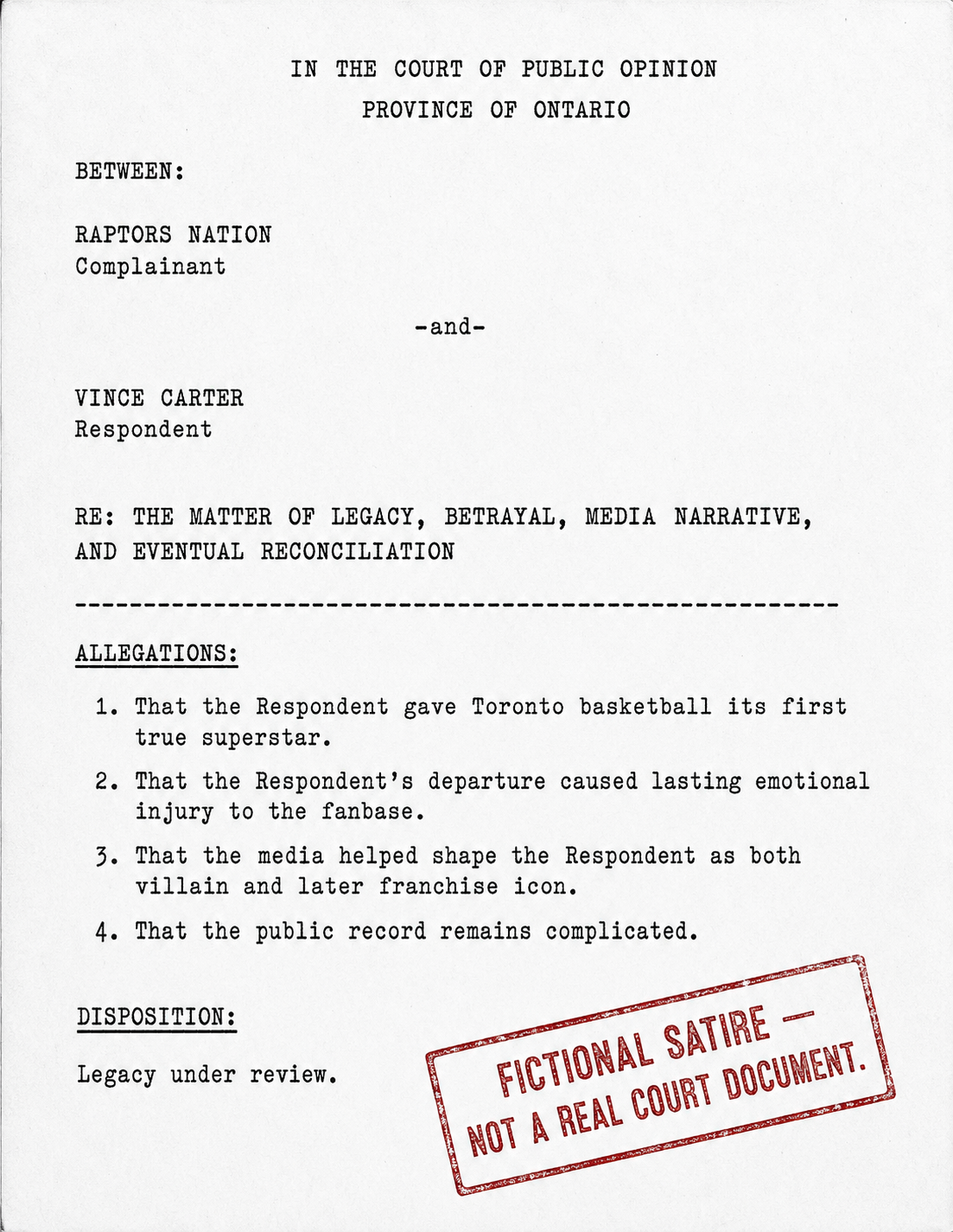
Case No. 15: Toronto spent twenty years prosecuting Vince Carter. The evidence was real. The verdict was incomplete.
With Kawhi Leonard reportedly coming back to Toronto, now is the perfect time to look back at the first superstar the Raptors ever had.
NBA.com News Services reported that the Raptors agreed to reacquire Leonard from the Los Angeles Clippers, sending out Brandon Ingram, Gradey Dick, and draft compensation for the player who once arrived as a rental and left as a champion.
Kawhi came, stayed one season, delivered the championship, and left with a city’s gratitude intact. He never had to grow old with the franchise. He never had to argue with management through newspapers. He never had to play through the dull ache of a deteriorating relationship while a young basketball country watched every possession for signs of loyalty.
Before Kawhi, there was Vince Carter...
For many Canadian basketball fans, Carter was not simply the first Raptors superstar. He was the first proof that the Raptors could matter. He arrived in 1998, won Rookie of the Year, turned the Slam Dunk Contest into a cultural phenomenon and pushed Toronto into the playoffs. In a 2024 TSN retrospective, Ryan Horne wrote that Carter played 403 games for Toronto, made five All-Star teams as a Raptor, and averaged 23.4 points, 5.2 rebounds, and 3.9 assists with the club. Years earlier, Jesse Campigotto of CBC Sports called Carter Toronto’s first and most polarizing pro basketball star.
Then he left.
The departure became one of the ugliest break-ups in Canadian sports. The simple version was easy to understand and even easier to repeat: Carter quit on the Raptors, forced his way out, hurt the city, and then instantaneously rediscovered his game in the Garden State. For years, that simplistic version was enough, every return to Toronto was met with boos inside Air Canada Centre, the kind usually reserved for the Bruins and Canadiens.
Every highlight in a Nets uniform reopened tender wounds. Every retelling returned to the same handful of exhibits: the trade request, the “I don’t wanna dunk anymore” line, the Seattle allegation, the post-trade scoring surge, and the infamous interview with the great John Thompson.
Twenty years later, the story has not been disproved.
But it has become harder to tell cleanly.
Part One: The Story Everyone Thought They Knew
To understand why the betrayal frame took hold, it is necessary to resist the temptation to begin with forgiveness.
In 2004, fans did not have two decades of hindsight. They had a superstar who looked unhappy, a team stuck in NBA purgatory, a new general manager, another new coach, and a steady flow of reporting that suggested the relationship was broken. In September 2004, CBC Sports reported that Carter wanted out of Toronto, quoting reports that he had discussed his feelings with general manager Rob Babcock and then first-year coach Sam Mitchell.
That distinction mattered less publicly than it should have. Once the phrase “wants out” was heard, every moment was interpreted through it. The Raptors were not just losing games. They were losing control of the story.
Carter had once been the player whose dunks sold the future. In November 2004, when he said he did not want to dunk anymore and called dunking overrated, the quote became more than a comment about style, injury, or aging. It was treated as evidence. The public effect was severe because Carter’s identity in Toronto had been built around his unique ability to dunk.
Then came the trade.
On December 17, 2004, Toronto sent Carter to the New Jersey Nets for Alonzo Mourning, Aaron Williams, Eric Williams, and two first-round picks. The package became part of the grievance almost immediately. Mourning refused to report to Toronto. The return looked less like a reset than a public admission that the franchise had lost all possible leverage.
Now he was gone, and the Raptors had little to show for it.
Still, the public narrative did not fully harden until January 2005, after Carter’s TNT interview with John Thompson. Thompson asked whether Carter had pushed himself as hard as he should have in Toronto. Carter’s answer began: “In years past, no.” He spoke about being fortunate to have talent, being spoiled by it, and feeling renewed by a fresh start.
To Carter, the answer may have been reflective, maybe even broader than the final months in Toronto. To fans, it sounded like a confession.
That is the moment the story became morally complete. The trade demand gave it structure. The no-dunking quote gave it a symbol. The poor return gave it humiliation. The New Jersey surge gave it statistical force. The Thompson interview gave it Carter’s own voice.
In that context, the fan reaction was not mysterious. It was the response of a city that believed it had watched a star check out from a relationship before formally ending it.
Part Two: Inside the Organization
The problem with the old story is not that it was invented. The problem is that it was incomplete.
By 2004, Carter’s relationship with the Raptors had deteriorated through several overlapping pressures: injuries, losing, turnover, questions about influence, management change, coaching change, roster frustration, and a franchise still learning how to manage a superstar.
Carter’s early Toronto years were physically punishing. In his CBC Sports retrospective, Jesse Campigotto described how things changed after the 2001 playoff run, when Carter began dealing with knee problems that affected his availability, explosiveness, and relationship with the fan base.
Carter’s performance in Toronto before the trade had also dropped sharply, then rose dramatically in New Jersey. That split is why the injury explanation never fully controlled the story. Statistics do not prove mens rea. They do explain why the mens rea became the question.
The relationship was also damaged by instability. Carter had gone from the face of a rising franchise to a star surrounded by new coaches, new executives, roster frustration, and an organization that did not yet have much practice managing a player of his stature. In his interview with John Thompson, Carter pointed directly to the churn around him, saying Toronto had gone through multiple coaches and general managers during his time there. He also described feeling as if the burden of the Raptors’ problems often fell on him personally, rather than on the organization as a whole.
That does not erase Carter’s responsibility. He said things that damaged him. He allowed the trade-request story to dominate. His play plummeted compared to his past years in Toronto and his public tone often made things worse.
But it does complicate the prosecution.
A player can want out in July and regret the cost in December. A franchise can feel forced to move a star and still mismanage the process. A fan base can be right to feel hurt and still not have the whole story. A relationship can be broken without either side owning up to their poor behaviour.
That is especially important with the Seattle play-call allegation, one of the most vivid claims from the breakup. The story has lived for years as part of the Carter mythology, but it should not be treated the same way as Carter’s public trade frustration or his John Thompson answer. The trade demand was reported. The interview exists. The production swing is measurable. The Seattle allegation remains much murkier.
That matters because some stories survive not because they are best proven, but because they fit the mood. By December 2004, almost any story suggesting Carter’s disengagement could travel quickly because the public was ready to believe it.
Part Three: The Media Ecosystem
The key media question is not whether journalists invented the Carter story. The stronger question is how a cluster of real but incomplete facts became the dominant frame.
In 2004, the loudest available voices were Carter, management, coaches, anonymous sources, columnists, broadcasters, and angry fans. Missing, or at least underdeveloped, were the people who could have explained the internal machinery in detail: ownership, medical staff, assistant coaches, front-office figures, Carter’s camp, and executives willing to give a full timeline of how the relationship collapsed.
The result was a story built from fragments.
A trade request is easy to report. A quote about dunking is easy to replay. A scoring average is easy to compare. A bad trade return is easy to condemn. A fan booing is easy to film.
Organizational dysfunction is harder. Medical decline is harder. Broken trust is harder. Front-office incentives are harder. A superstar’s private uncertainty is harder. So the simpler frame had a built-in advantage.
That is where media ownership and media incentives matter.
There is not enough evidence to claim that Toronto media companies deliberately set out to protect the Raptors or bury management’s role in the Carter breakup. That would require proof the public record does not provide. But it is fair to ask whether the structure of Toronto sports media made certain stories easier, cleaner, and more profitable to tell.
The Raptors were not just a basketball team. They were part of MLSE, a growing sports-and-entertainment company. MLSE’s corporate history shows that Maple Leaf Gardens Limited purchased the Raptors and Air Canada Centre in 1998, then rebranded as Maple Leaf Sports & Entertainment. By 2001, the company had also launched team-branded specialty channels, including Leafs TV and Raptors NBA TV.
That matters because the team, the arena, the broadcasts, the sponsors, the executives, and the media environment were not completely separate worlds. They were overlapping parts of the same local sports machine that is MLSE.
This does not prove a conspiracy, but may rather suggests an incentive structure.
For the Raptors, the cleanest public version of the Carter breakup was that the organization had been forced into a bad situation by a disengaged star. That framing protected the franchise from a harder question: how did the first true superstar in team history become so alienated that Toronto had to trade him for a return almost immediately viewed as inadequate?
For media outlets, the betrayal frame was commercially powerful. It had a hero turned villain, a wounded city, a bad trade, a dramatic interview, and a fan base ready to argue. It produced debate. It produced reaction. It kept people watching, reading, calling in, and booing.
For reporters, access also mattered. Sports journalism depends on relationships with teams, executives, players, agents, coaches, and broadcasters. Nobody needed to be ordered to protect the Raptors for the institutional imbalance to matter. The team would remain in Toronto. Carter was leaving. The franchise was the permanent asset. The player became the moving target.
That imbalance shaped the story.
The Raptors would continue supplying games, locker-room access, media availabilities, executive interviews, and broadcast content. Carter, once traded, became an opposing player. His side of the story became easier to reduce to clips and quotes: “I want to be traded,” “I don’t wanna dunk anymore,” and “In years past, no.”
The dominant narrative benefited the Raptors in one major way: it made the trade feel like an unfortunate necessity rather than a shared organizational failure. It benefited media companies in another way: betrayal was simpler and more emotionally profitable than institutional ambiguity. It did not benefit Carter, whose own public comments were often fragmented, reactive, or self-damaging.
That does not mean Carter was treated unfairly in every report. Much of the reporting was based on real evidence. CBC Sports reported his trade demand in 2004. Ryan Horne’s TSN retrospective noted the sharp divide between Carter’s incredible highs and devastating lows in Toronto. Jesse Campigotto’s CBC Sports piece traced the same arc from rookie sensation to polarizing exit. The facts were real.
The problem is that those facts were often easier to arrange into a moral case against Carter than into an institutional case study about a young franchise that failed to manage its first superstar.
The missing questions were larger than one player.
Why had the roster stalled after the 2001 playoff run? What promises, if any, had been made to Carter about input? What role did ownership play? How did the franchise evaluate his injuries? How much did constant management and coaching turnover affect him? How close were alternative trades? When exactly did Carter’s camp want out, and when, if ever, did that change?
Those questions might have complicated the story in real time. Most fans did not get them.
The later ownership history makes the media question even more relevant, though as context rather than proof. In 2024, Kristen Shilton reported for ESPN that Rogers purchased Bell’s 37.5 percent stake in MLSE for $4.7 billion, giving Rogers majority control of Canada’s largest sports conglomerate. MLSE owns the Raptors, Maple Leafs, Toronto FC, Argonauts, Marlies, and Raptors 905.
That later consolidation did not cause the 2004 Carter coverage. But it shows where Toronto sports was heading: toward a model where teams, arenas, broadcasters, telecom companies, and content platforms were increasingly tied together.
Modern Raptors coverage also shows how ownership remains a live part of the team’s story. In 2024, Aaron Rose wrote for Sports Illustrated’s On SI about Masai Ujiri’s relationship with Edward Rogers and MLSE ownership, including past reporting that Rogers had been reluctant to re-sign Ujiri during 2021 contract discussions. That story belongs to a different era, but it reinforces the broader point: in Toronto, basketball decisions, corporate ownership, media rights, and public messaging are deeply connected.
In that kind of ecosystem, making the team look incompetent is rarely in the broad business interest. The franchise is the long-term asset. The player is temporary. That does not mean reporters were ordered to protect management. It means the system naturally gives more repetition, stability, and authority to the institution than to the departing star.
Carter lost the trade.
But he also lost the media structure around it.
Part Four: Twenty Years Later
The later record did not absolve Carter. It widened the room.
In 2014, the Raptors played a tribute video for Carter during a game against Memphis. The night became one of the most important public turning points in the relationship. In Barry Jordan Chong’s 2024 Toronto Life interview, Carter remembered being told a video might be shown but not knowing how the crowd would respond. At first, there were boos. Then the building shifted. The boos gave way to applause, and Carter became visibly emotional.
That night did not rewrite the past. It changed the emotional permission structure around it. Fans who had booed Carter for years could stand without feeling they had surrendered the grievance. They could acknowledge what he had meant before arguing about how he left.
By 2024, reconciliation had become official. Carter entered the Basketball Hall of Fame and the Raptors prepared to retire his jersey. In that same Toronto Life interview, Carter admitted the boos had affected him and said he never saw himself as a villain, even though he knew he was perceived as one.
The Toronto Sun captured the next stage. Before the jersey retirement ceremony, Ryan Wolstat wrote that Carter became emotional while speaking to reporters and said fans could have frustrations, but should understand the whole story before articulating anger if they did not know what had been happening behind the scenes.
That comment is central to the case, but it also needs scrutiny. Carter’s desire for fans to “understand the whole story” is not itself proof of what happened. It is a primary source for his current position, not a neutral reconstruction. Still, it points toward the missing heart of the saga: the public version was emotionally powerful, but Carter believes it lacked context.
The later material also shows how winning changed memory. Ryan Horne’s TSN retrospective suggested that time, along with the Raptors’ 2019 championship, helped heal wounds. Before the title, Carter’s exit symbolized Toronto’s fear that it would always be abandoned by stars. After the title, Carter could be reclassified as part of the origin story rather than the wound that defined the franchise.
Kawhi’s reported return makes that contrast sharper. Kawhi Leonard left Toronto after delivering the championship. Carter left before the Raptors had learned how to recover from losing a superstar. One departure was wrapped in gratitude. The other became a referendum on loyalty.
Part Five: Reconciliation
Reconciliation did not require everyone to agree about 2004. It required the franchise and its fans to decide that the ending was not the only part of the story worth preserving.
That is why the jersey retirement mattered. Carter’s No. 15 was not just raised for statistics, though the statistics justify recognition. It was raised for what he made possible: sellouts, television attention, children pretending to be Air Canada, and a basketball culture that would later produce Canadian NBA players in numbers that would have seemed unlikely when the Raptors were born.
Jesse Campigotto made that point for CBC Sports back in 2014, years before the jersey retirement became reality for some fans. Even then, Carter’s legacy was already bigger than the bitterness of the trade. He had inspired a generation, even if that generation inherited the argument over how he left.
The harder truth is that reconciliation often arrives before certainty. Fans did not get every document. They did not hear every internal conversation. They did not receive a complete media archive tied in a ribbon. They received time, new memories, a championship, Carter’s tears, and a franchise willing to formally honour him.
That does not mean the betrayal narrative was false.
It means it was incomplete.
The better question now is not whether fans were wrong to boo. Based on what they knew in 2004 and 2005, their anger was understandable. The better question is whether the media and the organization gave them enough information to understand the difference between quitting, declining, hurting, posturing, forcing leverage, reacting emotionally, and living inside a broken franchise-player relationship.
Those are not the same thing.
The Carter story endures because it asks Toronto to confront how sports memory is made. A public narrative begins with facts, but it does not become history until those facts are selected, repeated, framed, and emotionally organized. The Carter narrative was built from real evidence. Later evidence did not demolish it. It complicated it.
Now Kawhi is reportedly back, and Toronto can revisit its first superstar from a different place. The franchise no longer needs Carter to stand for everything it lost. It can let him stand for what he was: the player who made the Raptors visible, the star whose exit hurt deeply, and the unresolved case study in how a city turned incomplete information into certainty.
Maybe that is the only honest ending.
Not vindication.
Not prosecution.
A record reopened.
Sources
CBC Sports. “Vince Carter demands trade: report.” September 16, 2004.
“Carter Transcript with John Thompson.” Transcript of Vince Carter’s 2005 interview after the trade to New Jersey.
Rose, Jalen. “Story Time With Jalen Rose: The Vince Carter Body Slam.” Transcript.
Chong, Barry Jordan. “‘The boos did get to me’: Vince Carter on becoming the first Raptor to have his jersey retired.” Toronto Life, October 30, 2024.
Wolstat, Ryan. “Emotional Vince Carter wants fans to ‘understand whole story’ of exit.” Toronto Sun, November 2, 2024.
Horne, Ryan. “The highs and lows of Carter’s memorable seven years with the Raptors.” TSN, October 31, 2024.
Campigotto, Jesse. “Vince Carter: His rise and fall with the Raptors.” CBC Sports, November 19, 2014.
D’Souza, Alyssa. “The complex relationship between Vince Carter and Toronto.” The Brock Press, October 25, 2024.
NBA.com News Services. “Reports: Raptors agree to acquire Kawhi Leonard in trade with Clippers.” Updated June 30, 2026.
Rose, Aaron. “Raptors President Opens Up About His Relationship With Team Ownership.” Sports Illustrated, September 30, 2024.
Shilton, Kristen. “Rogers buys majority stake in Maple Leaf Sports & Entertainment.” ESPN, September 18, 2024.
“Maple Leaf Sports & Entertainment.” Wikipedia.